We had finally made it.
After seven days on electric bikes, approximately 175 miles along the Portuguese Coastal and Litoral routes of El Camino de Santiago, Alexis and I walked our bikes into the enormous square in front of the Cathedral of Santiago de Compostela.
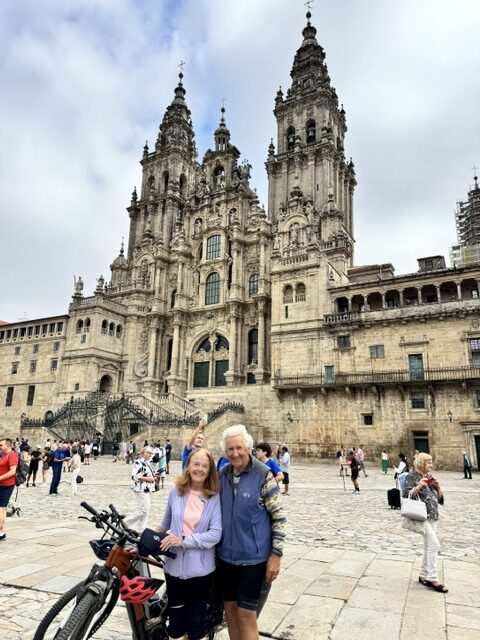
I have already written about that moment—the emotion, the relief, the pride, particularly for Alexis after what had been a far more physically and mentally challenging journey than either of us had anticipated.
But there was one more part of the Camino that I wasn’t prepared for.
The cathedral itself.
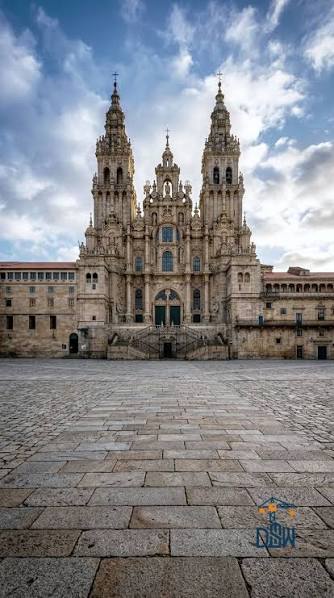
And I don’t mean simply the building, although the building is extraordinary.
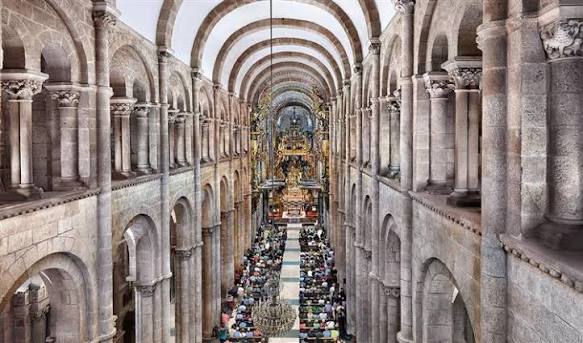
We took a private guided tour, which gave us a chance to understand what we were looking at rather than simply stare at it. Construction of the present cathedral began in 1075. Its great bones are Romanesque—massive stone columns, barrel vaults, a soaring central nave and a sense of permanence that is hard to describe.
And then, in the middle of all that massive Romanesque stone, you come to the main chapel.
Baroque.
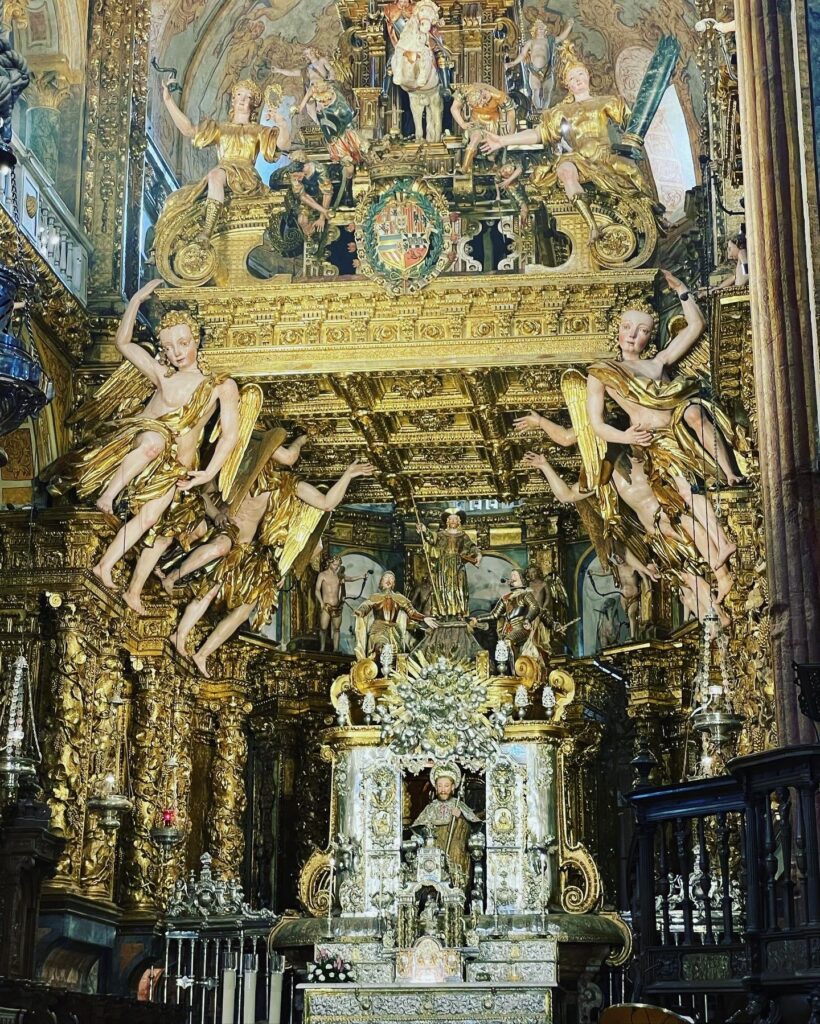
Gold and silver. Angels. Ornamentation everywhere. An elaborate canopy rising above the altar. The seated figure of St. James looking down on it all.
The contrast is startling.
And directly beneath that altar is the crypt containing the silver reliquary said to hold the remains of St. James the Greater—the apostle whose tomb has drawn pilgrims to Santiago for more than a thousand years.
And then there is the organ.
It is almost impossible to miss.
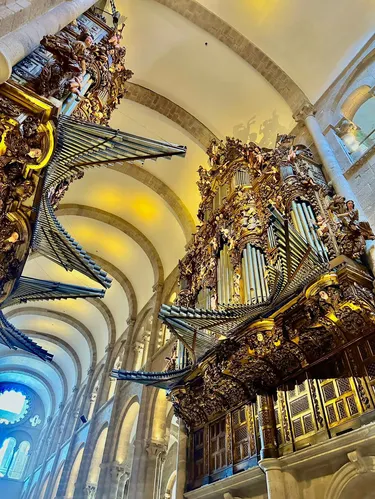
Two enormous gilded Baroque organ cases face one another high above the central nave, almost seeming to reach across the cathedral. The cases date from the early 1700s and are works of art in themselves, covered with carved figures and decoration.
The organ we heard, however, is much newer. It was built by the Italian firm Mascioni in 1977 and is apparently the only Mascioni organ in Spain. The instrument is divided between those two great cases, with three keyboards, pedals and 59 stops.
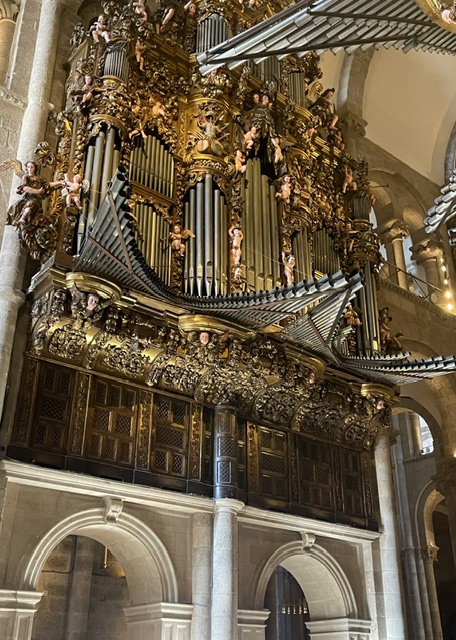
And the sound fills that enormous space.
During the Mass we attended, I remember thinking that the organ didn’t merely accompany the service. It seemed to become part of the architecture itself—the music coming from both sides of the nave and rolling through this immense stone building.
The cathedral employs three professional organists, and the organ is played daily at the principal Pilgrim Masses.
Another reminder that Santiago is not simply preserving an extraordinary old building.
It is still using it.
Whether you approach all of this as a practicing Catholic, a person of another faith, or simply someone fascinated by history, it is difficult not to be moved by it.
People have been coming here for more than a millennium—a thousand years.
And they are still coming.
That was the part that really got me.
The cathedral celebrates four Pilgrim Masses every single day.
We thought we would attend the noon Mass.
So did everybody else.
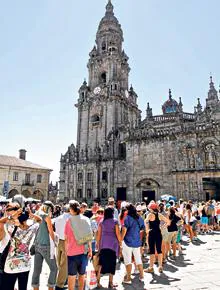
We arrived the first day and discovered a line stretching what seemed like blocks. The cathedral was full. No more people were being admitted.
Okay. We would try again the next day.
Same thing.
Another enormous line. Another completely full cathedral. Again, we couldn’t get in.
Now, understand the size of this place. This isn’t a little neighborhood church with 150 seats. The Cathedral of Santiago is enormous. We had been told it accommodates roughly 1,200 seated worshippers, with still more people standing.
And we couldn’t get in.
Twice.
Finally, for the evening Mass on our second day, we decided we had learned our lesson. We arrived an hour early.
We barely got a seat.
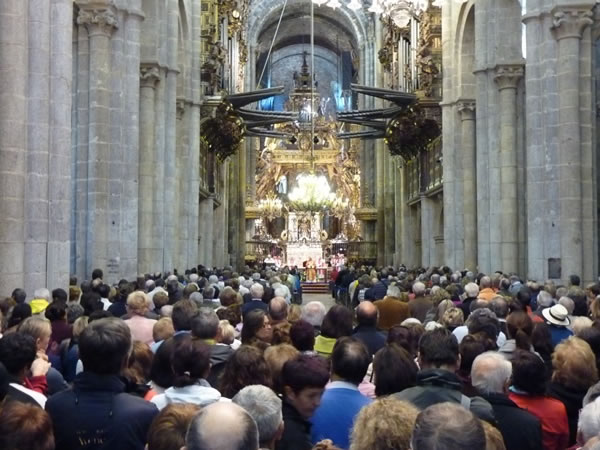
I sat there looking around at this immense church, every pew filled, people standing, pilgrims everywhere, and I began doing the arithmetic.
Four Pilgrim Masses every day.
Roughly 1,200 seats.
And, at least during the busy Camino season when we were there, these services were not lightly attended. They were packed.
Completely packed.
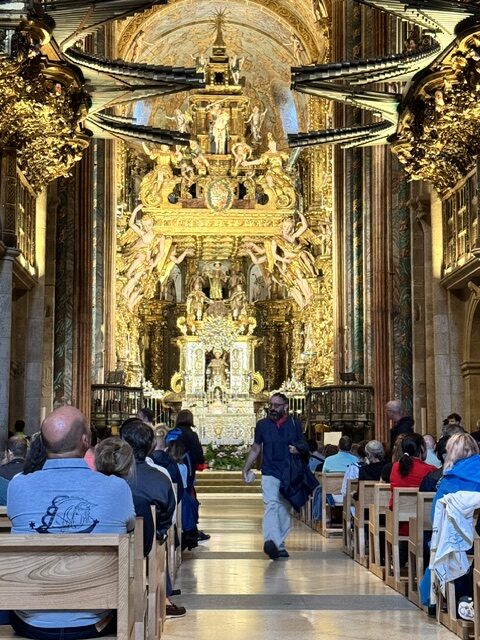
We knew because we had been turned away from the noon Mass two days in a row, along with hundreds of other people waiting outside.
Think about what that means.
Four services.
Perhaps 1,200 or more people at each one.
That is approaching 5,000 people in a single day attending Mass in this one cathedral—and potentially more when you include those standing.
Then they do it again the next day.
And the next.
And the next.
I have no idea where Santiago ranks among the great pilgrimage churches of the world. Lourdes, St. Peter’s and other great shrines undoubtedly welcome enormous numbers. But sitting there and realizing that approaching 5,000 people could attend Mass in this one cathedral on an ordinary day during the Camino season—and that they do it again the next day—was staggering.
Obviously, the crowds are smaller during the winter months, when relatively few pilgrims are making the Camino. But during the pilgrimage season, the sheer number of people passing through this cathedral—worshipping, praying, reflecting, giving thanks, seeking solace, or simply sitting quietly after their journey—is extraordinary.
I have been in some of the world’s great cathedrals, but I couldn’t remember ever seeing anything quite like this.
Not merely thousands of visitors streaming through to admire a famous building.
Thousands of people gathering, service after service, for the purpose for which the cathedral has existed for centuries.
That distinction stayed with me.
And then there were the pilgrims themselves.
Consider what happened the day we rode into Santiago.

After completing the Camino, a pilgrim goes to the Pilgrim’s Reception Office and presents his or her pilgrim credential—the little passport that has been stamped along the way at churches, cafés, hotels, hostels and other stops.
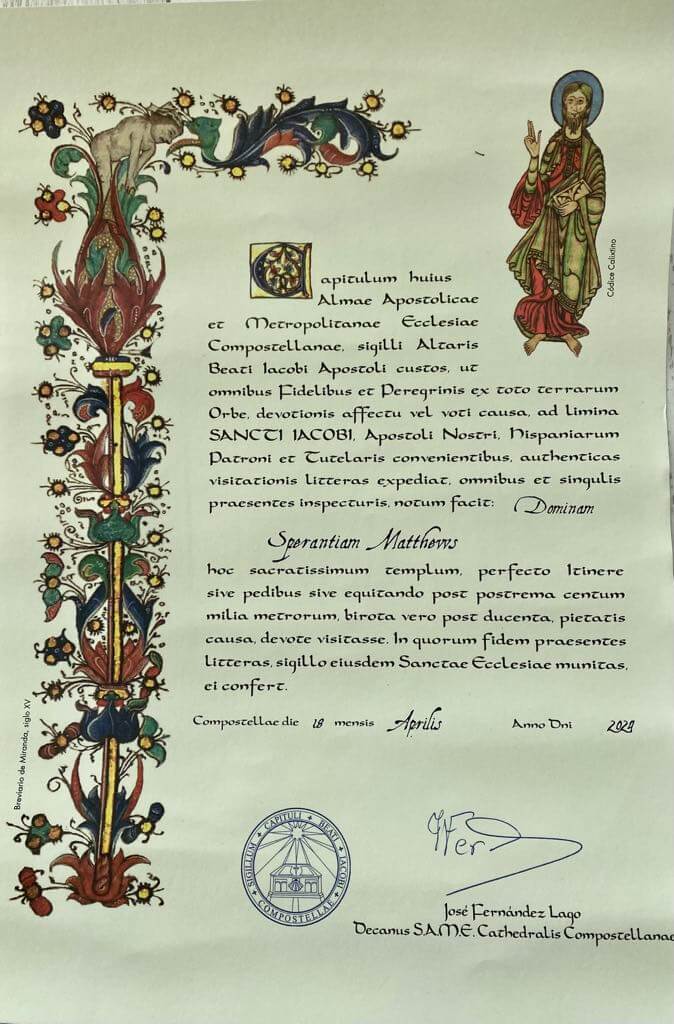
We presented ours and received our Compostelas, the certificates recognizing completion of the pilgrimage.
When we arrived around noon, Alexis and I were numbers 1,366 and 1,367 for the day.
Read that again.
It wasn’t the 1,366th pilgrim of the month.
It wasn’t the 1,366th pilgrim of the week.
It was Monday, around lunchtime.
And more than 1,300 pilgrims had already arrived ahead of us that day.
By the end of that Monday, 2,782 pilgrims had received their Compostelas.
And the next morning?
It started all over again.
The larger numbers are even harder to comprehend.
In 2025, 530,987 pilgrims received the Compostela in Santiago—the highest number ever recorded.
That works out to an average of roughly 1,450 officially recorded pilgrims arriving every single day of the year, including the quiet winter months.
More than half a million people in a single year.
And remember, those are only the pilgrims who went through the formal process of receiving a Compostela.
They come from the French Way, the Portuguese routes, the English Way, the Northern Way and other routes that, like tributaries flowing into a river, eventually converge on Santiago.
Some have walked 70 miles.
Some 500.
A few have come much farther.
Some come for explicitly religious reasons.
Some are searching for something.
Some are marking a transition in their lives.
Some want the physical challenge.
Some want the history and camaraderie.
Some probably aren’t entirely sure why they came.
But eventually they all arrive at the same place.
That cathedral.
Sitting in that evening service, I began looking at the people around me differently.
Every one of those pilgrims had a story.
Every one had started somewhere else.
Every one had gotten up that morning, and the morning before that, and the morning before that, put one foot in front of another—or, in our case, gotten back on a bicycle—and kept going.
There were young people and old people. People who looked exhausted. People who looked euphoric. People sitting silently. People praying. People hugging. People crying.
And mixed among them were people from Santiago who presumably attend Mass there because it is simply their church.
Imagine that.
Your neighborhood church just happens to be the destination for one of the great pilgrimages of the world.
I have been fortunate enough in my travels to visit some extraordinary cathedrals.
St. Peter’s in Rome. Notre-Dame in Paris. Westminster Abbey in London. Salisbury Cathedral, with that magnificent spire rising over the English countryside. And here in Spain, the great Gothic Cathedral of León, whose stained glass alone can stop you in your tracks.
Each is remarkable in its own way.
Some overwhelm you with scale.
Some with beauty.
Some with architecture, history or art.
But Santiago felt different to me.
It wasn’t simply a monument that people were coming to see.
It was still doing what it was built to do.
That may be what I found most extraordinary.
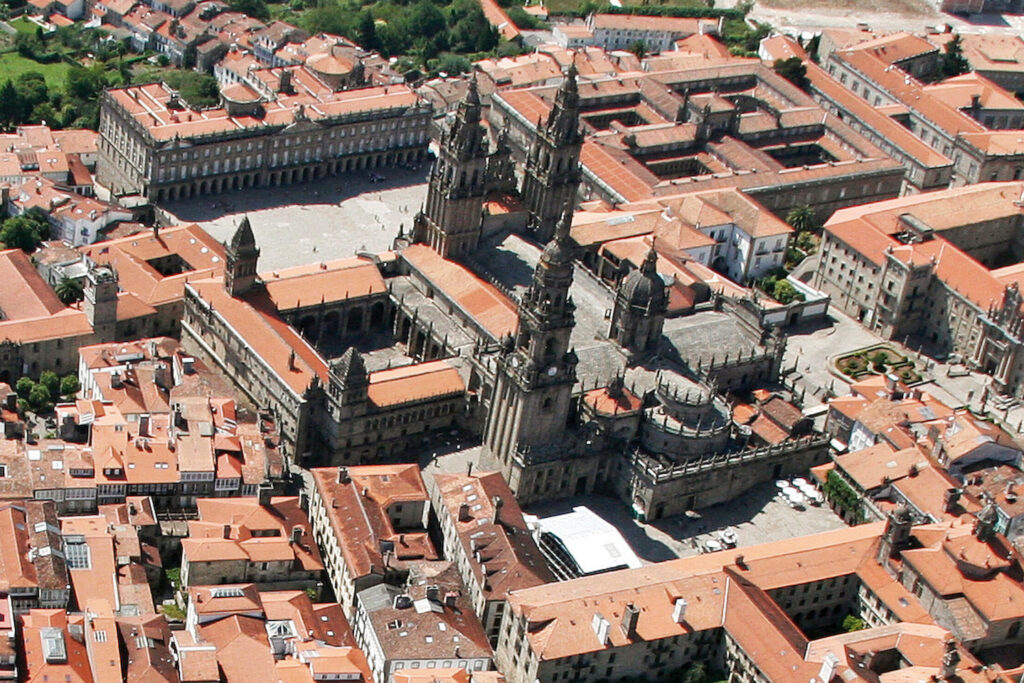
For more than a thousand years, people have traveled great distances to reach this place.
Today’s pilgrims arrive wearing Gore-Tex rather than medieval robes. They carry smartphones. Their backpacks are made of lightweight synthetic fabrics. Some of us even arrive on electric bicycles.
But they are still coming.
More than half a million of them last year alone.
And beneath that spectacular Baroque altar, the remains believed to be those of St. James still lie in the crypt.
Above them, day after day, Mass is celebrated.
Four times a day.
Thousands of people.
And outside, another wave of pilgrims is walking into Santiago.
Perhaps that is the image of the Camino I will remember longest.
Not the steep hills.
Not the rocks.
Not even walking our bikes into the square.
It may be sitting in that packed cathedral, surrounded by people from all over the world, and suddenly comprehending the scale and continuity of what we had become a very small part of.
Alexis and I were pilgrims number 1,366 and 1,367 that Monday.
Two people among 2,782 that day.
Two among more than half a million in a year.
Two among millions who have made their way to Santiago over the centuries.
And for a brief moment, sitting inside that enormous cathedral at the end of our Camino, we were part of that very long line.
Buen Camino.
Wow. Such a descriptive heart felt way to start my day. So happy for you two. That pilgrimage has always been on my bucket list. As I have aged I felt no way. Your blogs have shown there are so many ways this journey can physically and emotionally happen. Attending Mass and receiving holy communion in that historical cathedral and hearing that organ play, has once again put it on my list. The shorter paths would be my chosen paths .
I know you are very proud of yourselves and each other. You should be. Thanks for sharing.
Beautiful reflection! Thank you for sharing your thoughts and feelings about the Camino, pilgrims and the amazing, magnificent Cathedral too! What a feat it is to experience the long journey( I have done it). and what rewards await in Santiago!
Bless you both on your current adventure! Hugs! Mary
Amen! May the Grace of God shine brightly upon you in the days ahead and in the hereafter. We’ll done!
God, how great thou are, how great thou are……..
And I thought Milan’s Duomo Cathedral was remarkable – this sounds spectacular. You really captured the essence of the experience.
Congratulations to you and Alexis for your perseverance.. Heavy electric bikes are challenging indeed.
See you soon
Bruce and Janice