People do El Camino de Santiago for all kinds of reasons.
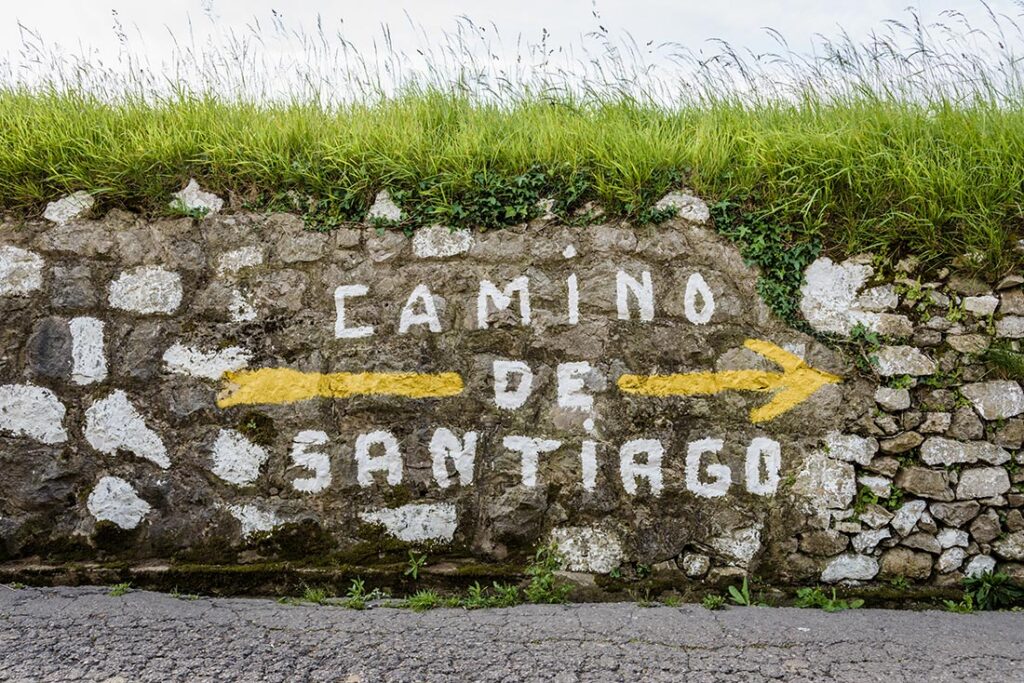
Some come as religious pilgrims.
Some come for spiritual reasons.
Some come hoping for time to reflect—to think about where they are in life, where they have been, and where they may want to go next.
Some come for the exercise.
Some for the challenge.
Some simply because they have always wanted to do it.
Alexis may have discovered another category.
She spent seven days on guard.
That is the phrase she used when we talked about the experience afterward.
Not relaxed.
Not contemplative.
Not lost in thought while moving peacefully through the countryside.
On guard.
All the time.
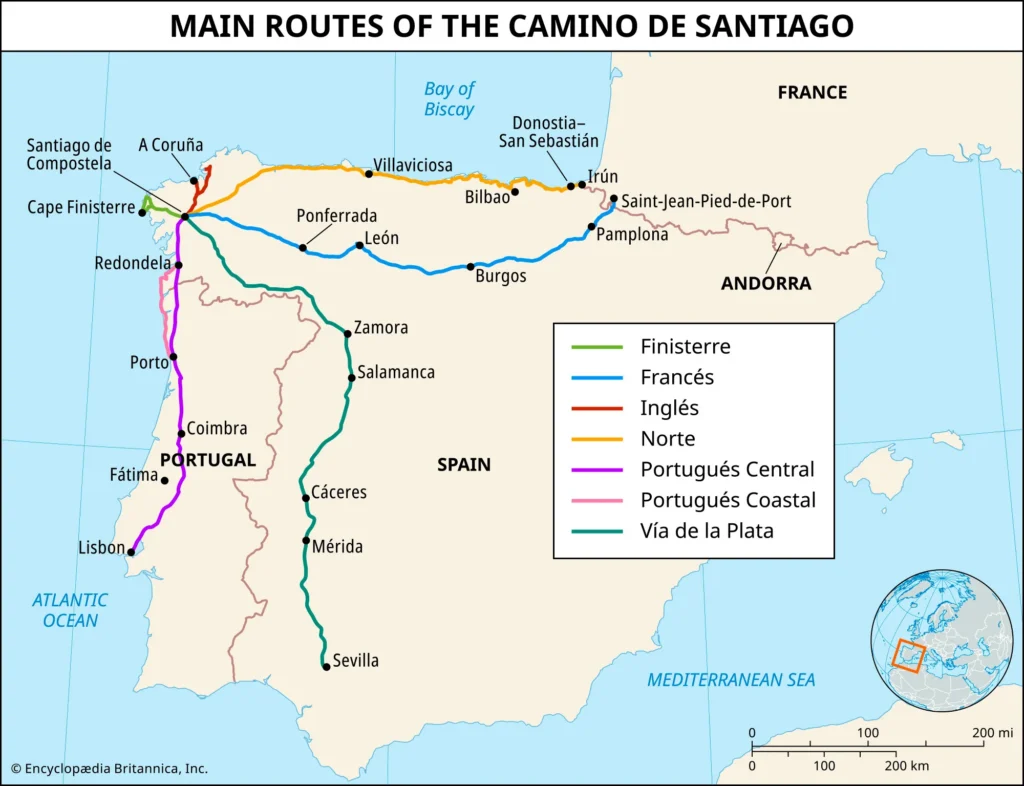
I have already written about the extraordinary variety of terrain we encountered while cycling the Portuguese Litoral route of El Camino from Porto to Santiago.
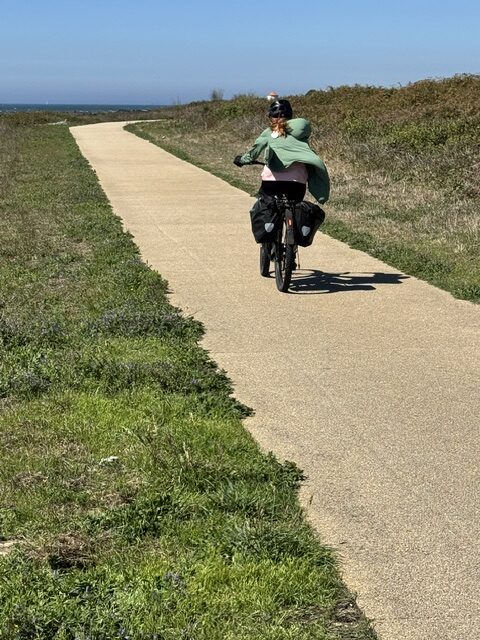
For sure there were beautiful stretches of paths, fields, lanes, and even asphalt.
Unfortunately, there were not enough of them.
There were cobblestones.
Pavers.
Dirt.
Grass.
Sand.
Tree roots.
Loose gravel.
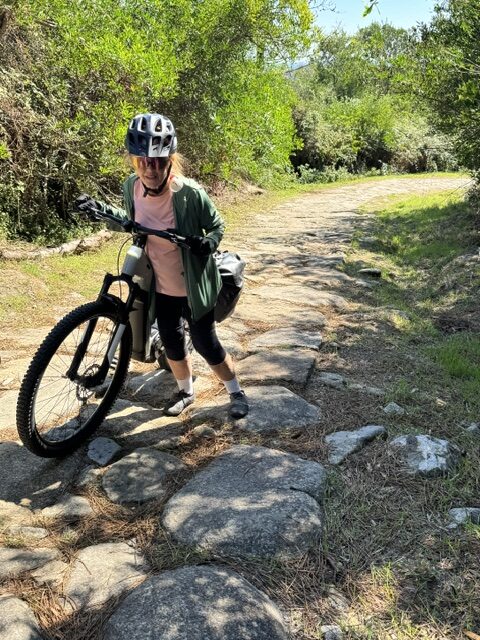
Huge uneven rocks.
Boardwalks—some wide and reassuring, others so narrow that a small error could put you into a railing, a bush, or somewhere you very much did not want to be.
And through all of it, Alexis was riding a heavy electric bicycle.
The electric motor certainly helped us climb hills and cover distances that would otherwise have been impossible for us.
But electric bicycles have another characteristic.
They are heavy.
Really heavy.
Add panniers over the rear wheel and you have a machine that requires considerably more confidence to balance, maneuver, stop, start—and occasionally wrestle back under control.
So, Alexis was on guard for the terrain.
But that was only the beginning.
She was on guard for the bicycle itself.
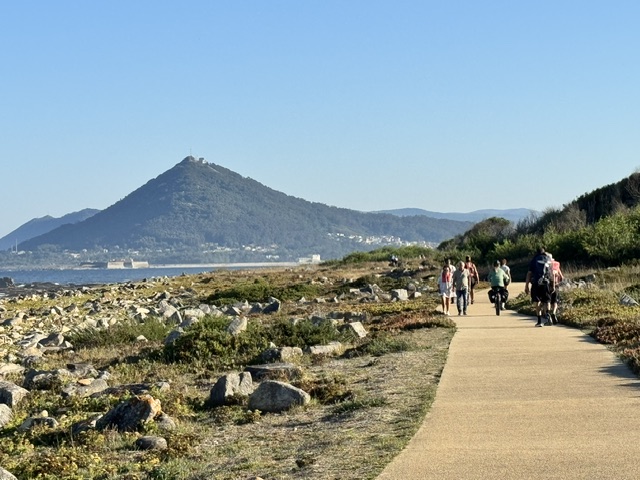
On guard for the peregrinos (the pilgrims) walking the same narrow paths we were cycling.
On guard for cars and trucks whenever the Camino put us onto a road.
On guard approaching blind corners.
On guard going downhill, worried that the bicycle might pick up more speed than she wanted.
On guard wondering what might be around the next bend.
A steep climb?
Loose gravel?
Another rocky path?
Deep sand?
A narrow boardwalk?
A group of walkers filling the trail?
For seven days, she rarely had the luxury of simply letting her mind wander.
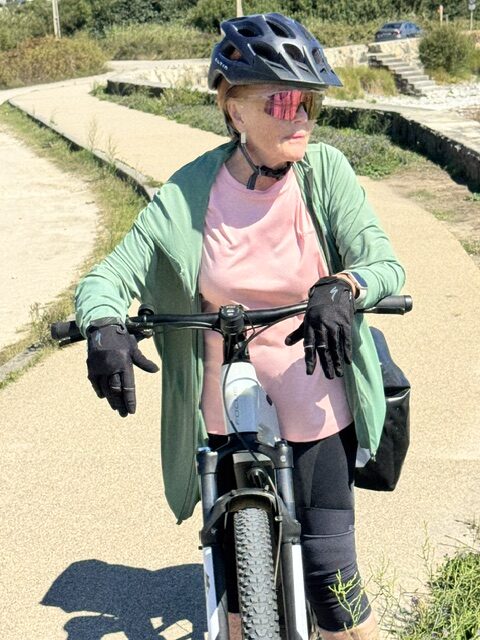
The Camino demanded her attention.
Right now.
Right here.
The next ten feet.
Stay balanced.
Watch the rock.
Watch the pedestrian.
Brake.
Turn.
Don’t go too fast.
Keep the bicycle upright.
This was not remotely the Camino she had anticipated.
And I confess that bothered me.
I had spent a lot of time planning this trip. I wanted Alexis to love it.
I knew that because of her knee, walking the Camino was not realistic. The electric bicycle seemed like the answer. It would allow her to experience something she otherwise could not experience.
And in many respects, it did.
Probably two-thirds of every day’s journey was wonderful.
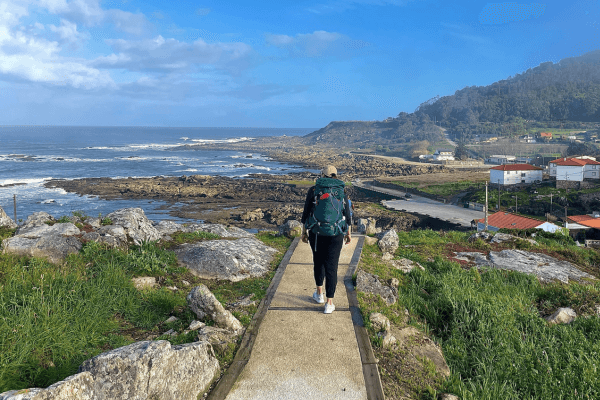
Beautiful coastline.
Villages.
Forests.
Churches.
Fields.
Other pilgrims.
Wonderful meals.
The satisfaction of moving steadily north toward Santiago.
But perhaps one-third of the time was somewhere between uncomfortable and genuinely harrowing for her.
And I found myself constantly trying to eliminate that one-third.
I studied maps.
I checked different Camino guides.
I looked for road alternatives.
I tried to anticipate the rough sections before we got to them.
I would tell her, “This next part should be fine.”
Sometimes I was right.
And sometimes I was spectacularly wrong.
One day I learned that lesson particularly well.
Ahead of us was a steep downhill section of the Camino consisting of dirt, crushed rock and sand.
I looked at it and thought: Alexis is not going to enjoy this.
So I decided to find her a safer route.
I consulted three different maps and guides.
I found what appeared to be an alternative that would take us briefly onto a main road, then onto a smaller road, and eventually reconnect us with the Camino after the difficult descent.
Perfect.
Or so I thought.
We turned off the main road onto what at first looked like a narrow paved lane.
Then the pavement disappeared.
It became dirt.
Then the dirt became what appeared to be an old logging road.
Two faint tracks through the forest.
Branches everywhere.
Pinecones.
Pine needles.
Debris.
Things you really don’t want beneath the wheels of a heavy bicycle.
We kept going.
Downhill.
Farther into the woods.
I kept thinking the path would improve.
It didn’t.
Finally, deep in the forest, the “road” simply ended.
There was nowhere to go.
My carefully researched, safe alternative had delivered us to a dead end in the middle of the woods.
Our only choice was to turn those very heavy bicycles around and retrace the same debris-covered path—this time uphill.
So much for my safe alternative.
There is probably a lesson in there somewhere about the limits of trying to smooth the road for someone else.
I wanted to give Alexis a Camino on which she could relax.
The Camino had other ideas.
And yet something interesting happened as the days went by.
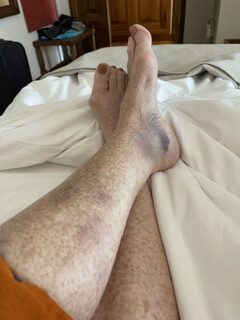
During the first two days, Alexis fell several times.
Into a bush.
Into a railing.
Trying to climb a hill.
Negotiating rocks.
She acquired bruises, scratches and a sore shoulder.
After that, over the remaining five days, she fell only one more time.
Unfortunately, that one was more dramatic. Her head hit the ground.
Fortunately she was wearing her helmet.
And, fortunately, Alexis remained very much Alexis afterward—although I decided that was probably not the moment to suggest she get back on the bicycle immediately.
What mattered more was what happened afterward.
She kept going.
Every day.
For seven days.
She remained cautious.
She remained on guard.
There were moments when I would look back at her face and see an expression that said very clearly:
Oh my God. What have I gotten myself into.
And then somehow she did.
That may be the part of her Camino that neither of us anticipated.
The Camino did not give Alexis seven peaceful days of reflection.
It gave her seven days of being tested.
It required concentration.
Judgment.
Courage.
And, over and over again, the willingness to keep moving when she was not entirely sure she wanted to.
Then came Santiago.
We reached the edge of the old city, got off our bicycles, and walked them the final distance into the great square in front of the Cathedral of Santiago de Compostela.
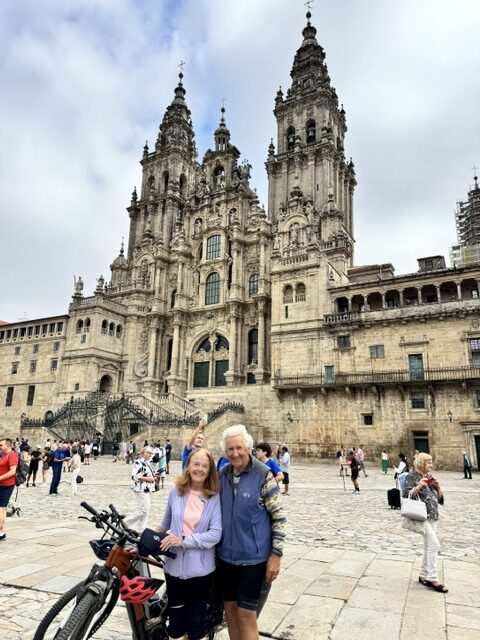
And that was when everything changed.
We embraced as never before.
Alexis became emotional.
Really emotional.
We both cried big time.
Excited.
Proud.
Relieved.
We had made it.
Seven days.
Approximately 175 miles.
All those rocks.
All that sand.
All those narrow paths.
All those moments of uncertainty.
All that being on guard.
Behind us.
And suddenly I understood that perhaps reflection does not always have to happen while you are making the journey.
Sometimes you are too busy making it.
Maybe the reflection comes afterward.
Maybe Alexis’s Camino wasn’t about quietly pondering life’s larger questions while pedaling through the Galician countryside.
Maybe it was about discovering something much more immediate.
She could do something that frightened her.
She could fall and get back up.
She could say, “No, I am not going down that path,” when she needed to.
She could be 77 years old, riding a heavy electric bicycle across Portugal and Spain, doing something very few people her age would even contemplate.
And she could finish.
I had wanted to give Alexis a better Camino.
A calmer Camino.
A safer Camino.
Perhaps even a more reflective Camino.
Looking back, I am beginning to think that was never mine to give her.
Each of us gets our own Camino.
Some people get prayer.
Some get solitude.
Some get answers.
Some get questions.
Some get aching feet.
Alexis got seven days on guard.
And at the end of them, standing in front of that cathedral in Santiago, she got something else.
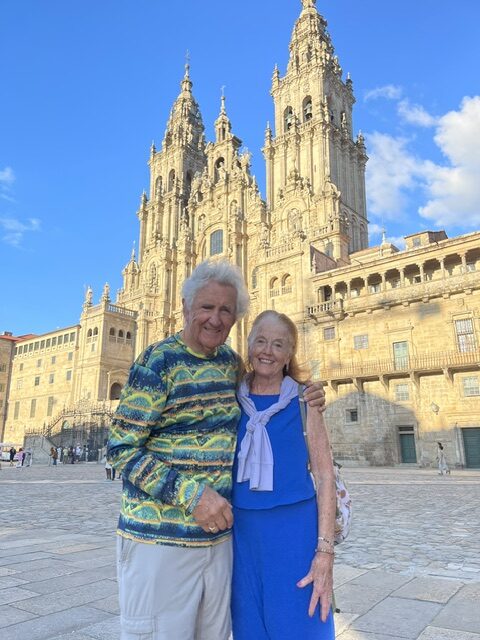
She got to say:
I was scared.
I wasn’t sure I could do it.
And I did it anyway.
Maybe that was her Camino after all.
Alexis, beware of Neil bringing up any suggestion of K2 or even its more famous taller challenge because cold and oxygen will also be a factor, Sherpa assist or not.
What an amazing story of grit and determination. Honestly not sure I could have done what you guys accomplished. Hope that you have many days of rest and relaxation now!! Thanks for sharing!
Giving Alexis a perfect Camino:
“ I am beginning to think that was never mine to give her.“
Your wisdom prevails ‼️❤️