Some numbers are simply too big to mean much at first.
That is one of the problems with a mission like Artemis II. The numbers are so huge, so far beyond ordinary experience, that they can slide right past the mind. You hear them, nod politely, and move on.
But if you slow down and sit with them, they become almost mind-bending.
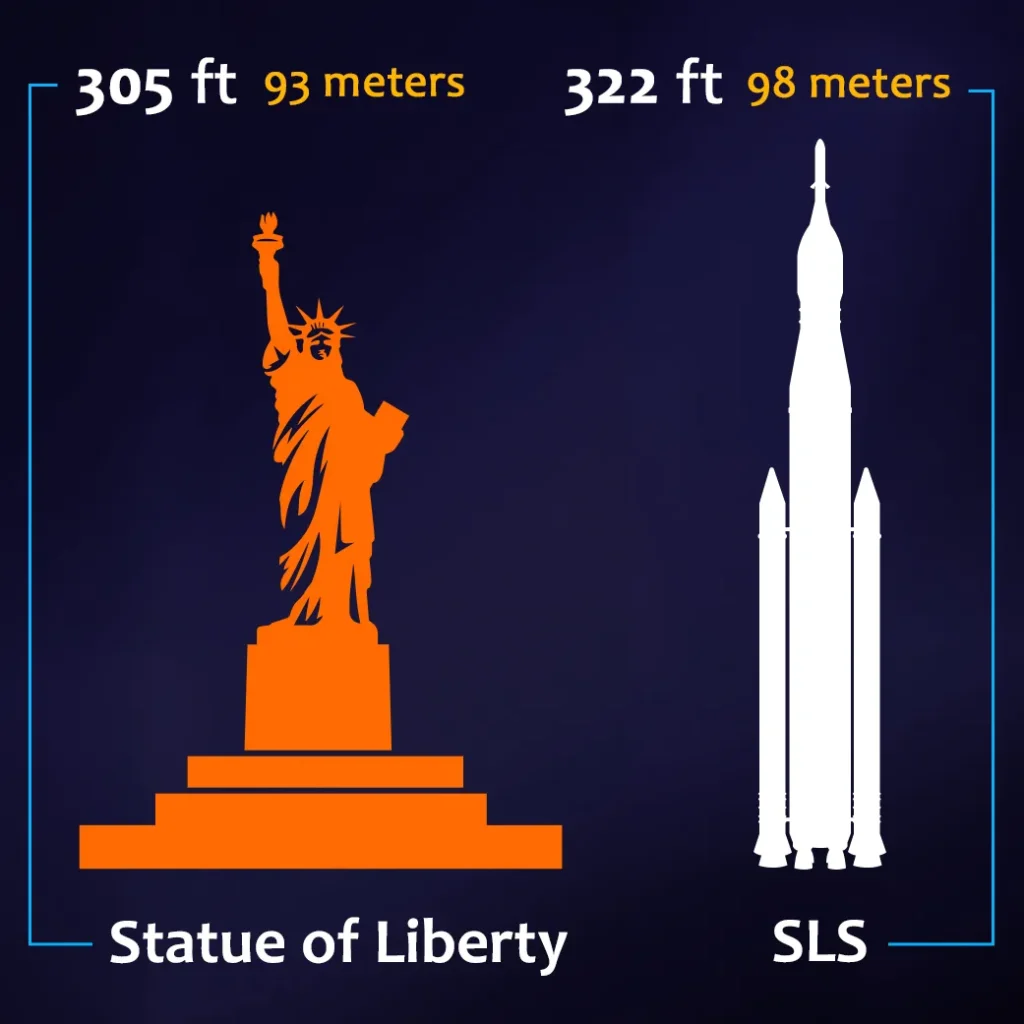
Start with the rocket itself. NASA’s Space Launch System, the rocket carrying Artemis II, stands 322 feet tall, weighs 5.75 million pounds when fueled, and produces 8.8 million pounds of thrust at liftoff. It is taller than the Statue of Liberty and more powerful than the Saturn V rockets that launched the Apollo missions.
Those are not just impressive facts. They are an attempt to describe force on a scale that most of us never encounter in ordinary life.
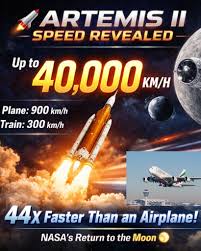
Then there is speed. NASA says SLS will help Orion reach about 24,500 miles per hour, the speed needed to send it to the Moon. At that velocity, the mind starts to lose its footing. A trip of roughly 2,800 miles — about the distance from California to Florida — would take less than seven minutes. A distance of about 45 miles — roughly Cape Canaveral to Orlando — would take about six and a half seconds.
Those are simple comparisons, but they help. They give a human foothold on a number that otherwise feels abstract.
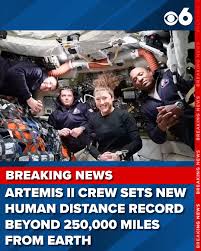
Then there is distance of a different kind. Many modern launches, including a good number of SpaceX missions, are headed to orbit around Earth — remarkable achievements, to be sure, but still relatively close to home. Artemis II belongs to another category altogether. At its farthest point, the crew is expected to travel about 252,000 miles from Earth and roughly 4,600 miles beyond the far side of the Moon.
That is not merely leaving the atmosphere. That is heading into deep space.

Then there is heat. When Orion returns to Earth, NASA says parts of the spacecraft will face temperatures of nearly 5,000 degrees Fahrenheit — about half as hot as the surface of the Sun. That is why the heat shield matters so much.
A machine built to survive the cold vacuum of deep space must also survive coming home through an inferno.
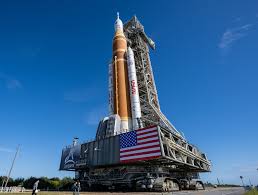
And then there is one of my favorite numbers of all: the crawler. This gargantuan vehicle hauls the rocket to the launch pad at all of one mile per hour when loaded. NASA says the crawler itself weighs about 6.3 million pounds and can carry up to 18 million pounds.
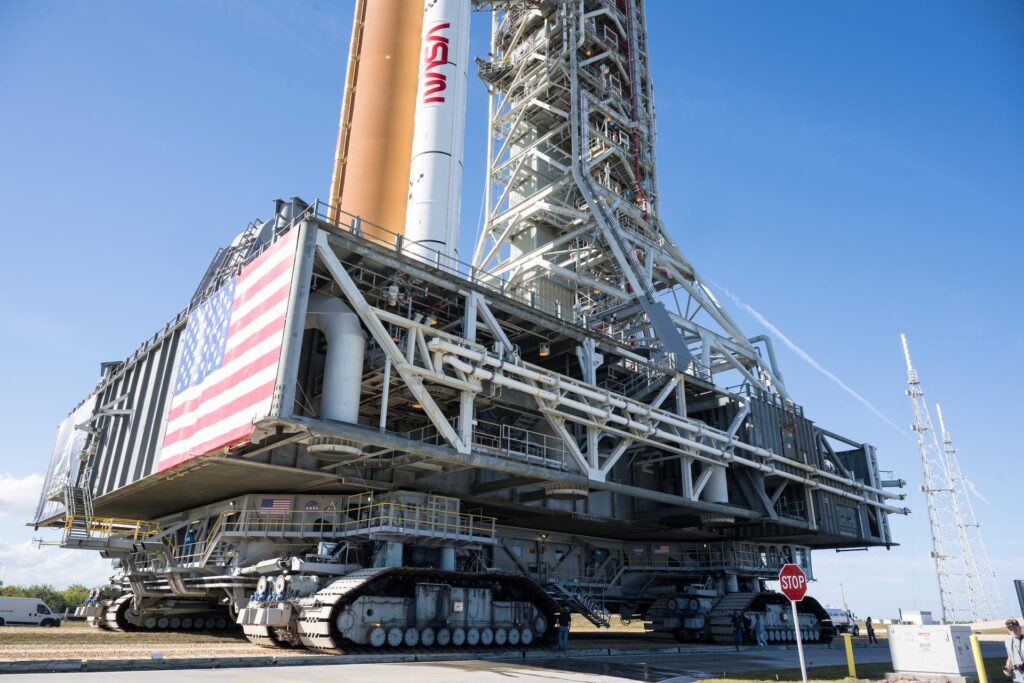
There is something almost comical about that. One of the most advanced missions in human history begins, in part, by creeping to the pad slower than many of us walk.
Even the individual pieces of the rocket stretch the imagination. Each of the two solid rocket boosters is 17 stories tall. And the intertank — the section that connects major parts of the core stage — is made of eight large panels fastened by 7,500 bolts.
Numbers like that begin to explain why a mission like Artemis II is not merely launched. It is assembled, tested, checked, rechecked, and worried over for years.
And then there is the mission itself. Artemis II is expected to last about 10 days and cover roughly 685,000 miles round trip. That is not just a quick dash into the sky. It is a sustained voyage out and back, with every mile depending on systems that have to work, people who have to get it right, and preparation that has to hold.
That may be what impressed me most over these few days in Florida.
Yes, the launch itself was spectacular. Yes, the delayed arrival of the sound was unforgettable. But beneath all of that lies something even larger: the astonishing scale of human effort. Years of preparation. Decades of accumulated knowledge. Thousands of people. Countless checks, rechecks, and safety procedures. Vast financial commitments. Sustained political commitments. All of it required to send four people around the Moon and bring them home safely.
It is hard to think in Artemis-sized numbers.
But maybe that is part of the point.
Projects like this remind us that human beings are capable of conceiving, building, and sustaining things far larger than any one person can fully understand. And in a cynical age, that may be one of the most hopeful reminders of all.
👍
Well said and indeed truly amazing!
Phenomenal! Appreciate your analogies and comparisons!
Now imagine if you can doing all that AND actually landing 2 humans and a rover on the surface of the moon. AND doing all that 57 years ago largely with slide rules instead of computers.