I know I’m not going to get any sympathy for what I am about to tell you.
But I am going to try anyway.
Alexis and I are now two days into our pilgrimage on the Camino de Santiago, the centuries-old network of pilgrimage routes that eventually lead to the Cathedral of Santiago de Compostela in northwestern Spain.
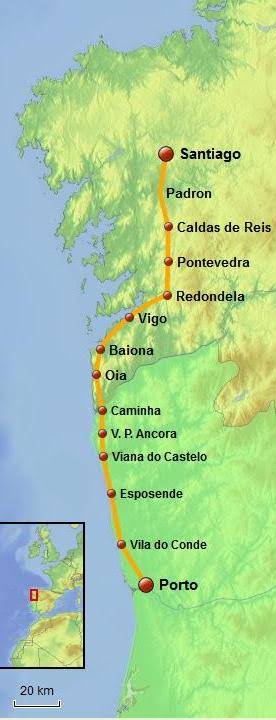
We are taking the Portuguese Camino, beginning in Porto. But even that requires a choice. There is the more traditional inland route, the Coastal Route, and then the Litoral Route, which, whenever possible, literally hugs the Atlantic coastline.
Naturally, we chose the Litoral.
We will travel approximately 175 miles over seven days, averaging roughly 25 miles a day.
Now here is where your sympathy for us may begin to disappear.
Most peregrinos—pilgrims—walk the Camino. Only about one in twenty does it by bicycle.
We are among the one in twenty.
But we didn’t stop there.
We are riding electric bicycles.
And because apparently even electric bicycles weren’t quite enough of a concession to comfort, we hired someone to transport our luggage from one night’s destination to the next. We do carry two panniers on each bicycle with the things we need during the day, but we are most definitely not hauling everything we brought with us.
And at night?
We aren’t sleeping in albergues, the traditional pilgrim hostels, some of which accommodate dozens of peregrinos in a single room filled with rows of steel, co-ed bunk beds.
No.
We have pre-booked hotels waiting for us each night.
So let me summarize.
Electric bicycles.
Someone else transporting our luggage.
Hotels.
Seven days.
What could possibly go wrong?
Quite a lot, as it turns out.
After two days of riding, we have discovered that this pilgrimage is considerably more difficult than we had imagined.
The first challenge is simply finding our way.
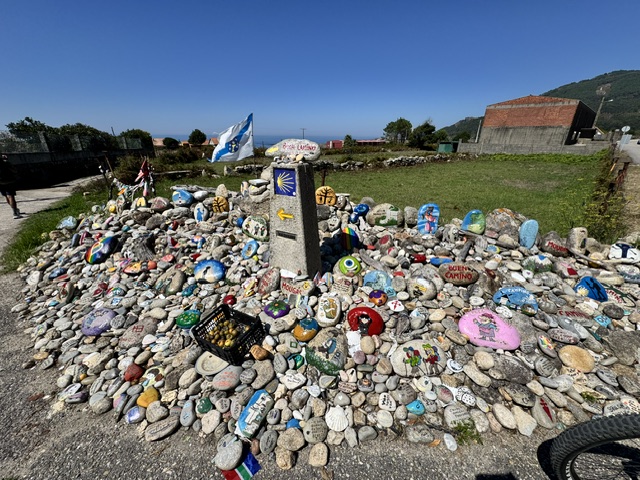
You would think that following one of the world’s great pilgrimage routes would be relatively straightforward. Follow the arrows. Follow the shells. Follow the path.
Not quite.
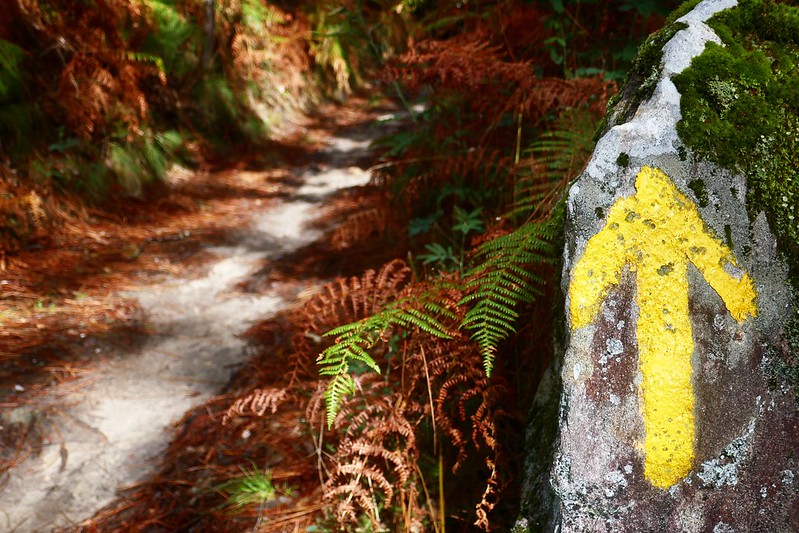
There are signs, arrows, markers and Camino shells, but there are also intersections, disappearing paths, conflicting possibilities and moments when you find yourself wondering whether the route could possibly be going where the sign seems to be sending you.
In just two days, I have already made several wrong turns, eventually realizing my mistake and having to retreat and find the Camino again.
But navigation isn’t the biggest challenge.
The terrain is.
Before I describe it, I should say that the coastline of northern Portugal is spectacular. We have ridden past beaches, dunes, fishing villages and seaside towns with the Atlantic alongside us for much of the journey. There are stretches where you almost can’t believe how beautiful it is.
And then you look down at what you are riding over.
There are, occasionally, perfectly normal asphalt roads.
Very occasionally.
At one point, amazingly enough, the Camino even put us onto a major state highway.
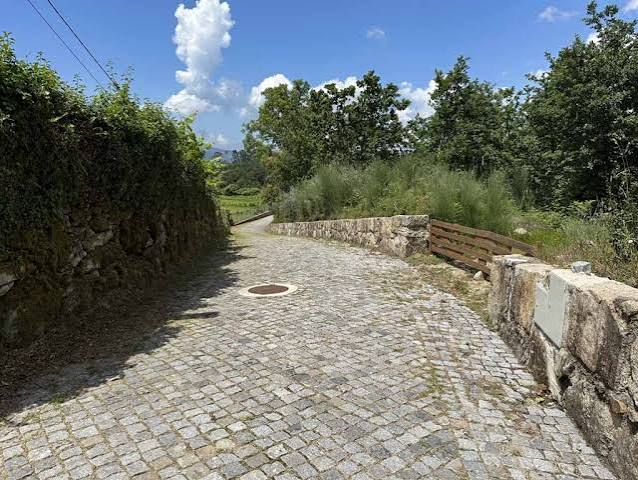
But most of the streets we ride on are closer in width to what Americans might think of as a driveway. And many are not made of asphalt or concrete.
They are made of stones.
Or pavers.
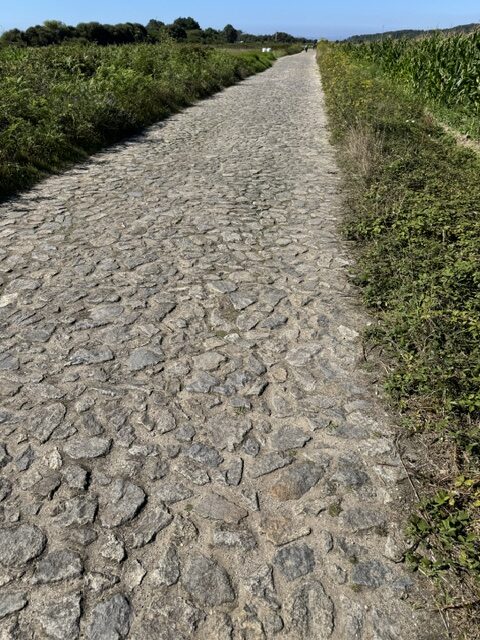
Or the beautiful Portuguese limestone cobblestones that look absolutely wonderful when you are walking through Porto and considerably less wonderful when you are bouncing across them on a bicycle.
They are not smooth.
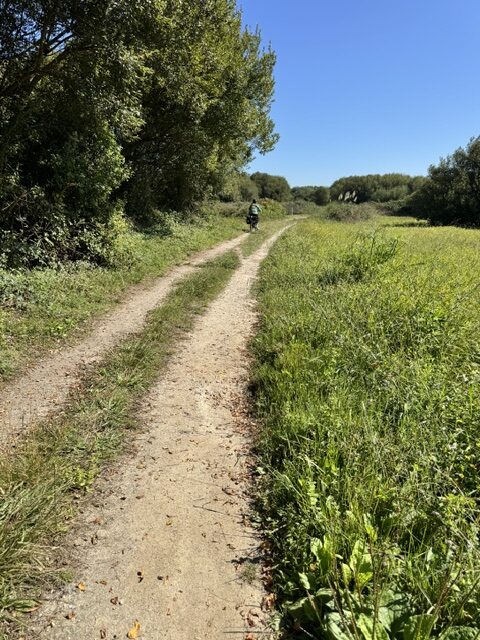
Then there are dirt paths, complete with holes, bumps, ruts and exposed tree roots.
There are grassy fields.
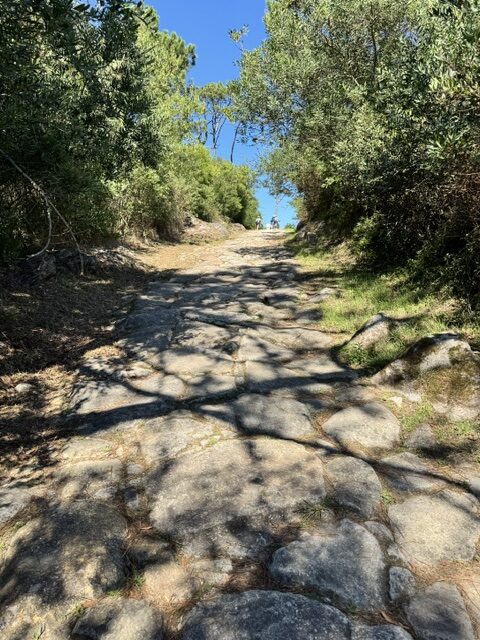
There are paths made from large, relatively flat stones that may have been perfectly serviceable for pilgrims several hundred years ago but were clearly not designed with an electric bicycle in mind.
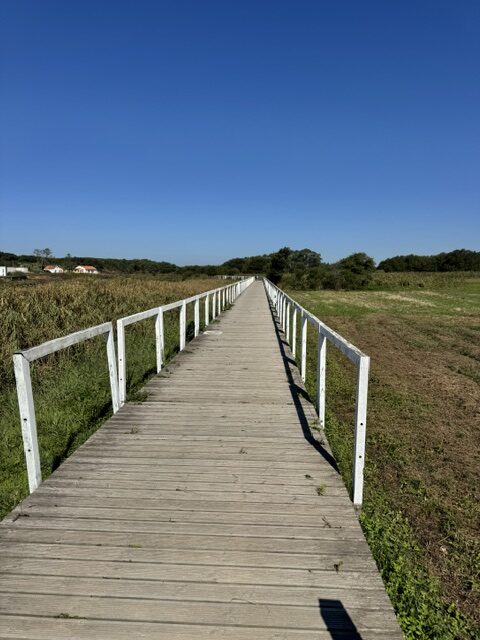
And then there are the boardwalks.
Miles of them.
Some are wide and wonderful.
Others are very narrow.
Some have railings on both sides.
And some have no railing at all.
And then there is sand.
Yes, sand.
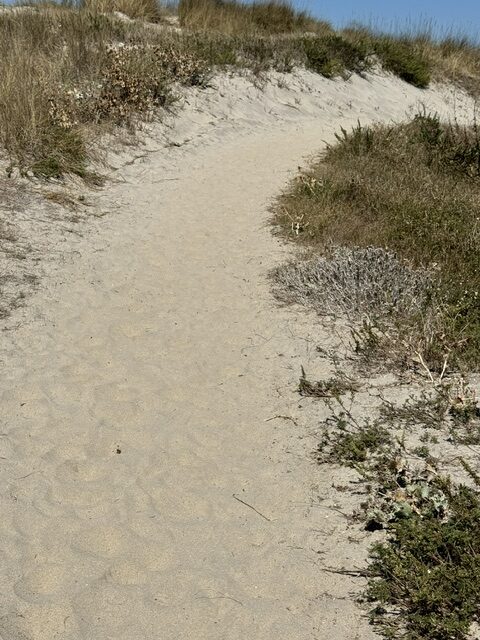
There have been several stretches where the sand was simply too deep for us to pedal through, even with electric bikes. We would get a few feet, lose momentum, wobble, stop, climb off and push the bikes until we reached firmer ground again.
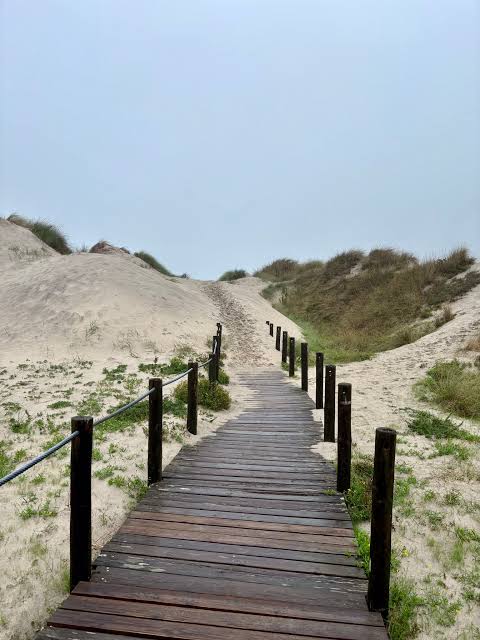
So by this point we have ridden—or attempted to ride—on asphalt, cobblestones, pavers, dirt, grass, rocks, boardwalks and sand.
I am beginning to wonder whether the Camino has any other surfaces left to surprise us with.
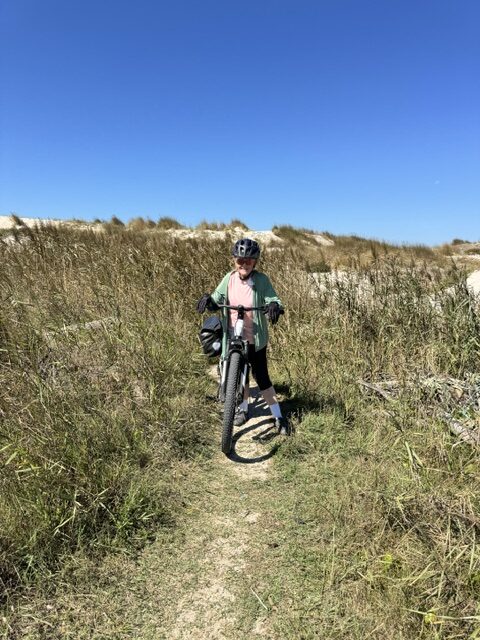
Which brings me to Alexis.
So far, Alexis is averaging approximately one fall a day.
Nothing serious, thankfully. A few bruises (8 on her lower left leg alone) on her legs and feet, some scratches here and there, and a very sore right shoulder.
She has run into a bush while negotiating a narrow sidewalk.
She has run into a railing on a narrow boardwalk.
She has fallen while trying to get enough momentum to pedal uphill.
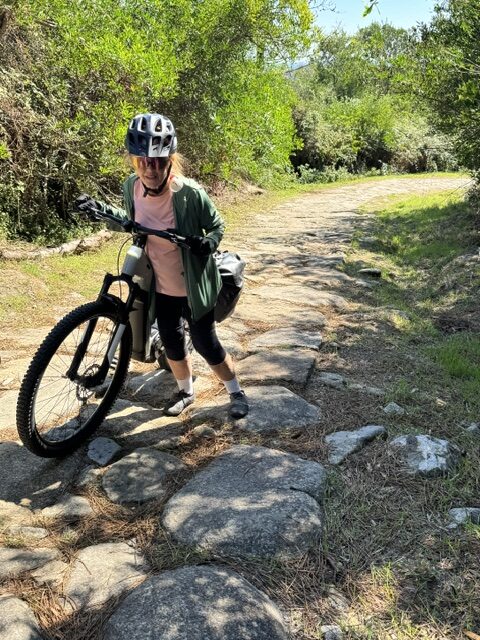
And she has encountered several paths filled with enormous stones where she has simply decided that discretion is the better part of valor.
On a couple of occasions, she has looked at what the Camino was proposing and announced, quite definitively:
“We are NOT going that way.”
And we didn’t.
I should also mention something we hadn’t fully appreciated before starting: electric bicycles are heavy.
Really heavy.
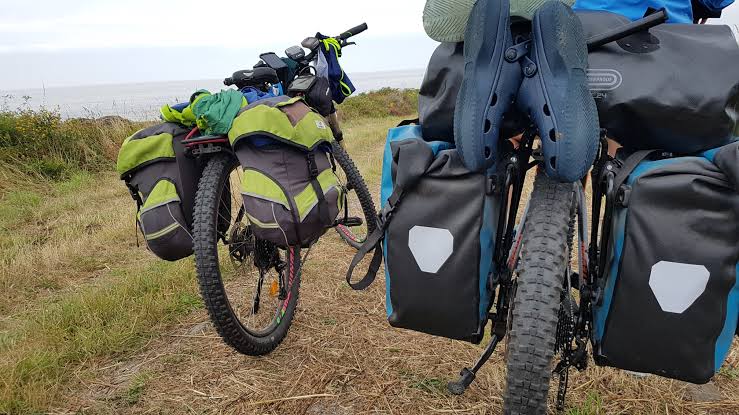
Add two panniers over the rear wheel and they become even heavier.
That matters enormously when the terrain becomes impossible—or simply too dangerous—to ride.
Then you have to get off.
And push.
Sometimes uphill.
Sometimes through sand or dirt.
Sometimes across rocks.
Sometimes along a path where one wrong step could put you and a very heavy bicycle on the ground.
And now, perhaps, the best indication I can give you of just how challenging these first two days have been.
Day One: 29.2 miles. Nine hours on the bicycles.
Day Two: 26.7 miles. Eight hours on the bicycles.
And those times don’t include our lunch stops.
Do the arithmetic.
We have been averaging somewhere between three and four miles an hour.
Three to four miles an hour!
You can practically walk that fast.
In fact, going that slowly on a bicycle is itself difficult. You are constantly starting, stopping, balancing, maneuvering, getting off, pushing, getting back on, looking for arrows, avoiding rocks and trying not to run into bushes, railings—or each other.
So there you have it.
Two people riding electric bicycles.
Having their luggage transported.
Sleeping in hotels.
Traveling along one of the most beautiful coastlines imaginable.
And asking for sympathy.
I suspect there will not be an outpouring.
But after seventeen hours on our bicycles over the first two days, Alexis and I are a little tired.
And more than a little humbled.
The Camino, it turns out, has found a way to make itself difficult despite all our efforts to make it easier.
We have five more days ahead of us.
We’re still smiling.
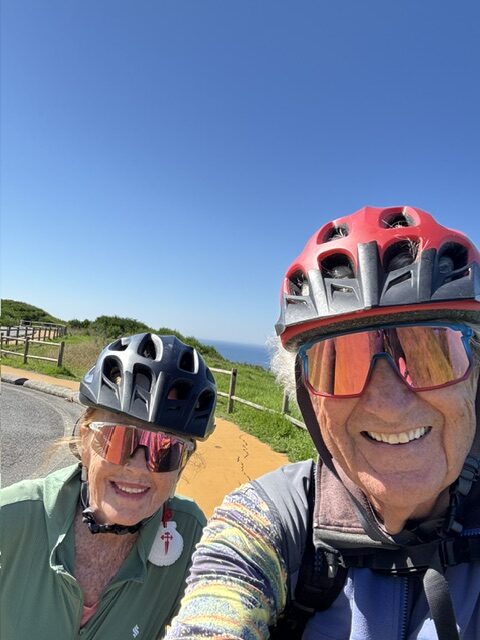
Alexis is still in remarkably good humor.
And tomorrow morning, we will climb back on those very heavy electric bicycles and continue north.
Although, if the Camino points us toward another path covered with challenging sand, cobblestones, roots or rocks, I already know what Alexis is going to say.
“We are NOT going that way.”
Surely there’s a comfortable cruise ship you could take from Porto to Vigo from which you could admire the coast line! Then hire bearers (porters) to take you the rest of the way via palanquin (sedan chair).
Save the ebikes for a safer more sensible terrain. Just sayin’!
Take that lady to Paris. NOW.
You are both brave and hearty, adventuresome souls! You write a terrific travel note! We can all visualize your experience, and yes, I give you both lots of sympathy!
Enjoy the delicious octopus and albarino wine at the end of every grueling day! I did the Camino on foot years ago and enjoyed it very much, especially the octopus!
My God there is a wonderful adventurous female version of Neil! Bravo to Alexis!
Oh my. I am sending some sympathy, encouragement and prayers that your energy and good nature continue and the one fall per day is not more serious.
I also know you have a wonderful three week trip planned at the end that you will both need and deserve.
It sounds like quite the metaphor for life – including the falls! Still smiling, making progress, using your bikes the best you can, experiencing the journey together. Keep on going! You’ve got a great story to share with the grandkids ( and the rest of us!).
No sympathy from us! Sounds pretty wonderful.
Praise God! He is impressed by your devotion…
Wow that is quite the adventure! Forgot about electric bikes being so heavy!! Am so impressed and proud of you guys!! I think you will have earned your weeks of lounging!!
I am curious to know if you met each day so far at your hotel-or was there a lag. You are so brave to be doing this. Only 5 more days to go. Keep safe, and enjoy a god spa at the end of it all. No more falls!!!!!
Neil—there is this new fangled thing called AI. You can ask questions, and believe it or not, frequently get really good answers. For example, you can ask it what the condition of the Camino is between A and B and what problems you might have traversing with E bikes. It may not be too late to save you trouble (and the risk igmf injury from falls!) for the rest of the trip. Just saying.
The Camino has its way of exposing a lesson to pilgrims that may not be evident at the moment.
Embrace the suffering and the beauty is revealed.
“Nothing great is ever achieved without much enduring.”
~ Saint Catherine of Siena (1347–1380)
I thought everyone knew that ebikes can be quite heavy. Perhaps shift to passenger rail? They could check your bikes and then you would have them with you for touring the area around Santiago.
Congratulations you two wonderful humans! Devoted to each other!
Your story makes me want to go again but not on EBikes! Buen Camino ❤️
Congratulations you two wonderful humans! Devoted to each other!
Your story makes me want to go again but not on EBikes! Buen Camino ❤️
Time to rest up on the Mediterranean Beaches 🏖️
Smiled as I read this! I so know what you are saying even though I walked it…it brought back memories. Glad you made it through!