Yesterday, Alexis and I ventured into Home Depot.

We had a shopping list of three items. Not exactly the materials required to build a house. Or even a doghouse.
First, we needed one of those mop-like things that cleans tile or marble floors. A Swiffer something-or-other. Second, a strip of rubber with adhesive backing that would hopefully prevent water from escaping from our shower onto the bathroom floor. And third, a little electrical gadget that supposedly tells you whether there is electricity flowing to an outlet or light fixture.
That’s it.
Three simple items.
How difficult could this possibly be?
Well.
For those of you who have never entered a Home Depot, imagine a warehouse roughly the size of Rhode Island, with shelves reaching toward the heavens and aisles disappearing into the distance.
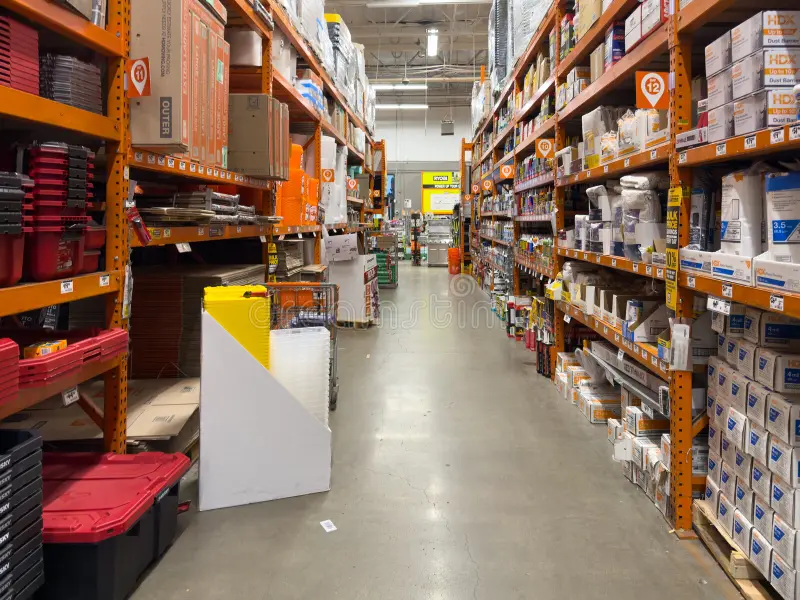
Every conceivable item associated with building, repairing, maintaining, or destroying a house appears to be somewhere inside. Thousands upon thousands of products. Most of which I couldn’t identify if my life depended on it.
And somewhere, buried among all this merchandise, were our three little items.
Now, I remember a very different kind of hardware store.
It was usually a modest establishment, perhaps a little cluttered, with a bell that rang when you opened the door. Behind the counter was a fellow who knew everything there was to know about plumbing, electrical wiring, nails, screws, and the mysterious workings of household appliances.
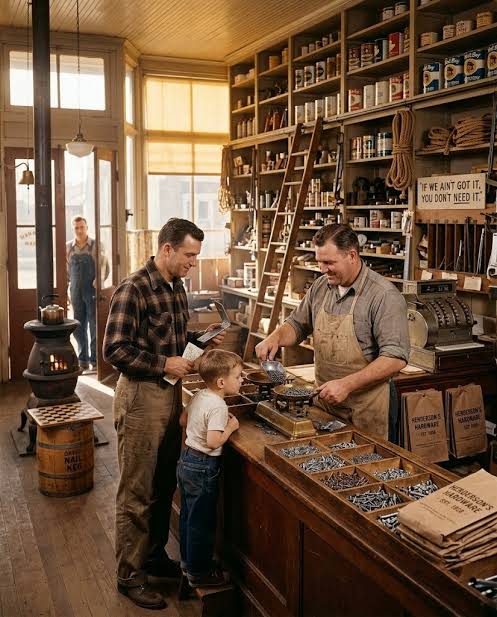
You could walk in holding some broken piece of equipment, without knowing what it was called, and explain your problem.
He would look at it, ask a couple of questions, and say, “Oh, you need one of these.”
Then he would reach into a drawer, produce a little gizmo costing 79 cents, and explain exactly how to install it.
You left not only with the necessary part but with a little more knowledge about how the world worked.
It was a learning experience.
Home Depot is something else entirely.
First, you have to find what you’re looking for. Which requires navigating dozens of aisles, each seemingly devoted to a different branch of engineering.
Of course, there are signs. But finding the correct aisle is one thing. Finding the correct product among the thousands of nearly identical products is quite another.
And then there’s the matter of getting help.
Where are the employees?
I occasionally spotted someone wearing an orange apron in the distance. But getting close enough to ask a question was another matter. And even if you found someone, what were the odds that they actually knew anything about the item you were looking for?
Some merchandise is even locked away, requiring the intervention of one of these elusive employees.
Apparently, customers are expected to do everything themselves—except touch certain things they might actually want to buy.
Now, I don’t want to be unfair. I’m sure Home Depot has some extraordinarily knowledgeable employees. I just wish I’d encountered a few more of them.
Eventually, we gathered our three purchases.
The Swiffer-like mop. The rubber weather seal. And something called a “Dual Range Voltage Detector with LED.”
I particularly liked the sound of that last item.
A voltage detector!
With LED!
It sounded like something a serious handyman would own.
I should confess that I have absolutely no idea how to use it. For all I know, it might detect electricity, measure the temperature of the moon, or communicate with passing spacecraft.
But I now own one.
Surely that counts for something.
And then came the final challenge.
Checking out.
In the old days, you took your purchases to a cashier. The cashier rang them up, told you how much you owed, took your money, and perhaps even put your purchases in a bag.
What a quaint concept.
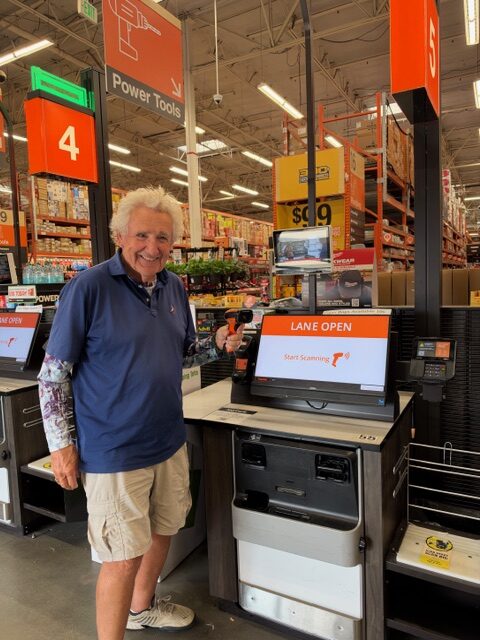
At Home Depot, apparently, the cashier is you.
There I stood, staring at a computerized checkout station with a screen, a credit card terminal, some kind of scanner, and an assortment of surfaces whose functions were not immediately apparent.
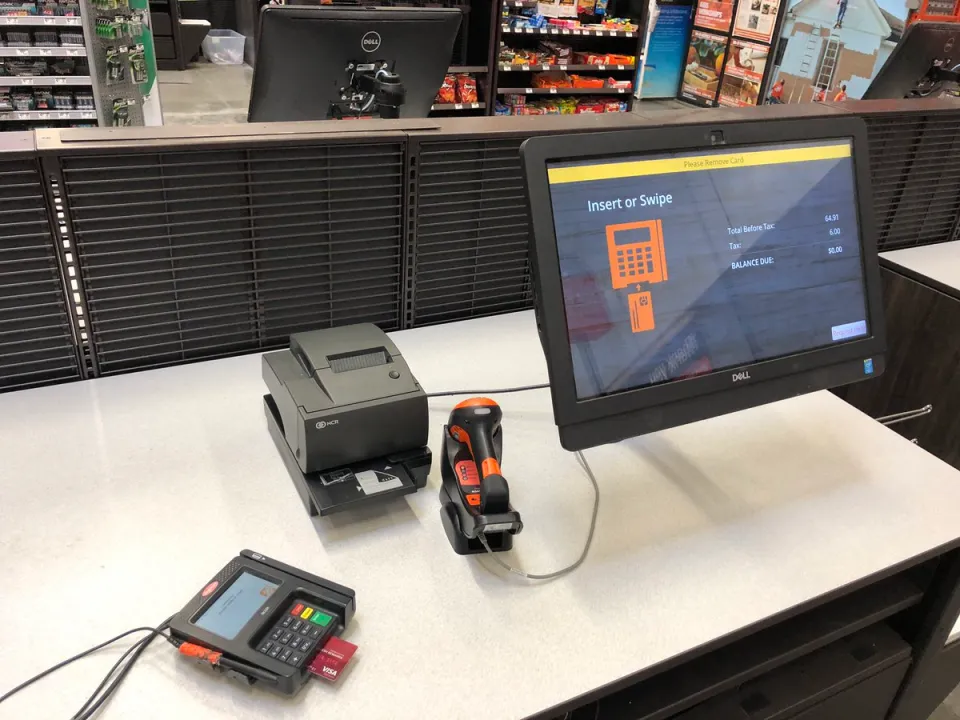
I was intimidated.
Fortunately, a young employee was nearby, assigned to help customers who had difficulty performing their newly acquired responsibilities as unpaid cashiers.
And he was terrific.
Patient, friendly, encouraging and with a big smile on his face.
He showed me the barcode scanner and explained how to use it.
Ah, yes. The barcode scanner. That little gadget that reads all those mysterious black lines printed somewhere on every product.
Simple enough, right?
Except that first you have to find the barcode.
Why do manufacturers apparently consider it necessary to hide these things?
I turned one item over. Then around. Then upside down. Then back again.
Finally, success!
Beep.
One down. Two to go.
My instructor then explained that after scanning each item, I had to put it on a particular counter to the left of the screen.
Not the right.
The left.
Apparently, the machine cared deeply about this distinction.
Eventually, after what seemed like an extended training session in retail operations, I had scanned all three items and deposited them in their proper location.
Then came the final step.
Press PAY.
Tap credit card.
Voilà!
Transaction completed.
I had successfully performed the work that Home Depot used to pay someone else to do.
And throughout this entire ordeal, standing next to me, was Alexis.
Watching.
Observing.
Witnessing my humiliation.
I had entered Home Depot hoping to project the image of a reasonably competent handyman, a fellow who knew his way around a mop, a strip of rubber, and an electrical instrument.
Instead, I was standing in front of a cash register, struggling to locate a barcode.
I have held some fairly responsible positions in my life. Managed large organizations. Supervised thousands of employees. Made decisions involving hundreds of millions of dollars.
But none of that prepared me for the left-hand counter at Home Depot.
At least the young man helping me maintained his composure.
Alexis was under no such obligation.
After recovering from this experience, I became curious about the origins of Home Depot.
And I discovered something rather ironic.
When Bernie Marcus and Arthur Blank founded Home Depot in 1978, they wanted enormous stores, huge selections, competitive prices—and knowledgeable employees who could actually teach customers how to fix things.

There’s even a wonderful story about an employee who talked a customer out of buying a $200 faucet by showing him how to repair his existing one with a $1.50 part.
Imagine that. A store employee who actually saved a customer money by teaching him something.
Marcus, who died in 2024, went on to become an extraordinary philanthropist, supporting medical research, veterans, autism programs, and the Georgia Aquarium. Blank has also become a major philanthropist.
These were remarkable men who built an extraordinary business.
But somewhere along the way, something seems to have gotten lost.
I remember the neighborhood hardware store, where you walked in with a problem and walked out with a solution—and usually a little more knowledge than when you arrived.
At Home Depot, I walked in with three simple things to buy and walked out having learned how to operate a cash register.
I suppose that’s progress.
And I still have absolutely no idea how to use my voltage detector.
But perhaps the most surprising discovery came later, when I asked Alexis what she thought of my performance.
I fully expected her to confirm my worst fears. That I had looked like a fumbling idiot, a man who might be reasonably competent at some things but was clearly out of his league at Home Depot.
Instead, she said she was proud of me.
Proud!
Apparently, she was impressed that I had been willing to admit I needed help—and actually ask for it.
Imagine that.
All this time, I thought I’d been making a fool of myself.
Turns out, the best thing I did at Home Depot was find another human being and ask him a question.
Which, come to think of it, is exactly what I used to do at the neighborhood hardware store.
Wow! Things have changed since COVID. If this is the HD just off Jefferson I used to get first class service there by several older chaps who were retired plumbers or electricians. However one chap there was as useless as handles on a snowball. He often was a Greeter, short guy with glasses and I avoided him like the plague because he always seemed to be wrong or stuck for even knowing the question.
Here on Vancouver Island, HD still gives the service that the founders envisaged BUT Rona (Canadian Co that bought out Lowes up here) turned exactly like what you now describe at HD. PS: Lowes in La Quinta used to be just as unhelpful, maybe HD is emulating that model If you want that old style service go to Ace Hardware. They had one in Old Town La Quinta and it may now be closed but I’m sure there still is one in Palm Desert. Very knowledgeable helpful people. About a mile down 111 past the Nest.
Incidentally, the first time I was at HD, Norb Witt drove me there in his Maybach! I’m sure you’ll remember him from the Pickleball Wars!
Neil-
Having had essentially the same experiences at Home Depot, I feel your pain. Btw, in both San Diego and Denver, we have had a bit more luck finding people to help at Lowe’s. But I agree that going to Ace Hardware ususally is a lot better.